
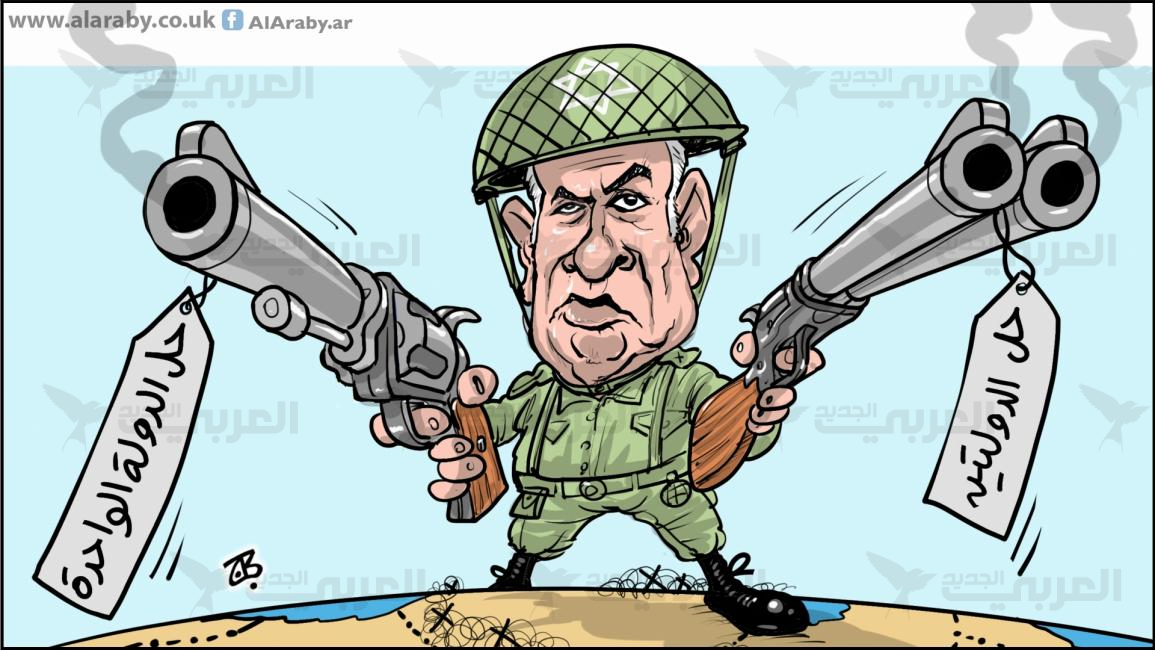

Hani Al-Masri, a Palestinian political analyst and columnist, argues that the two-state solution has come to be seen as “an illusion that cannot be realized,” while the one-state solution is treated as “a fantasy.” Once both options are pushed aside, he asks, in plain terms: “Where do we go from here?”
He argues that those who reject the two-state solution do so on the basis of facts imposed by the occupation, above all the settlement enterprise. With more than one million settlers in the West Bank and their deep entrenchment in Israeli decision-making, he says, the establishment of a truly sovereign Palestinian state on the 1967 borders has become “virtually impossible.” From this point of view, dismantling the settlements and removing the settlers is viewed as an “existential threat” to Israel that could tip it into internal civil war.
At the same time, he explains, opponents of the one-state solution dismiss it as “wishful thinking.” A single democratic state, in their view, would effectively “end the Jewish character of the state,” because it would quickly result in a Palestinian demographic majority. This scenario, Al-Masri notes, is rejected by an overwhelming majority within Israel, even more strongly than their rejection of a Palestinian state.
He points out that, despite starting from opposite positions, both camps end up in the same place: they “bow to the existing reality” and treat it as if it were carved in stone. The unspoken message becomes: “Nothing can be done.” People then scatter between those ready to “take anything on offer,” those who “reject everything” and wait for an unknown future, and those who retreat into a purely “rights-based” language. He criticizes this for ignoring the settler-colonial and racist nature of the Zionist project and for watering down the liberation character of the Palestinian cause. He stresses that the Palestinian people are “still on their land” and “still determined to fight for it,” and that the presence of more than five million Palestinians, most of them in the West Bank, compared to about one million settlers, alongside the recognition of Palestine by around 160 states (including four permanent members of the Security Council), means that the struggle for liberation and independence is “an uphill battle, but not a lost cause.” And even if it fails, he says, “other doors remain open,” including the one-state alternative.
He insists that changing the rules of the game requires forcing Israel, after shifting the balance of power, to choose “between continuing the occupation or remaining a Jewish state.”
He notes that critics of a Palestinian state argue, and he considers their case “serious, though not decisive”, that the two-state formula has turned into “a project of liquidation.” A state on only 22 percent of historic Palestine, they argue, amounts to surrendering the rest of the land and rights: “a huge price” in national, legal, political, and historical terms. The long pattern of offering sweeping Palestinian concessions in return for “minimal and reversible” Israeli gestures only encouraged Israel to dig in deeper, deny Palestinian peoplehood, and ask for more. Over time, what was once a compromise position was turned into a “maximum ceiling,” after Palestinians pre-emptively accepted land swaps, annexation of settlement blocs, and a demilitarized state with clipped wings , all “handed over in advance, for free, and without anything in return.”
In practice, he argues, this road led to shrinking the leadership’s real program to the mere survival of a tightly limited self-rule authority. This deepened after the unilateral implementation of the Oslo obligations. The horizon of Palestinian-Israeli relations was reduced to “security and economy,” even without negotiations or any political process since 2014. Political participation, he says, has increasingly been tied to accepting the PLO’s commitments, hollowing out real pluralism and democratic competition, locking dependence on the status quo in place, and continuing the step-by-step abandonment of the Palestinian historical narrative, all while inching toward Israeli demands to be recognized as “the state of the Jewish people,” at the expense of the unity of the people, the land, and the cause.
He also explains that opponents of the one-state path argue that clinging to “total liberation” or to a single state — with or without dismantling the Zionist project — is a case of leaping before looking and choosing “the impossible.” From their perspective, dropping the goal of ending the occupation in favor of slogans that “float above reality” risks undoing the Palestinian cause altogether, or at least dragging it back to a time of guardianship and containment before the world recognized the PLO as the sole legitimate representative of the Palestinian people.
Looking back, Al-Masri traces the evolution of the Palestinian national program. After the Nakba, it started with the goal of “full liberation and return.” After 1967, the October 1973 war, and the entry into the peace process, it shifted toward prioritizing a state on the 1967 territories. Without that shift, he argues, the PLO would have been pushed to the margins of Arab and international politics, especially after the Arab position moved from “what was taken by force can only be recovered by force” to the more limited aim of “removing the effects of aggression” through negotiation. The real problem, he says, was not adopting self-determination, return, and statehood, but turning this program into “a final ceiling instead of a stepping stone,” and making broad, unilateral concessions in advance without securing a state — ending instead with “a shackled autonomy” bound hand and foot by the Oslo framework.
He argues that this program could have remained transitional had it stayed anchored in ending the occupation and achieving independence while continuing the struggle for longer-term goals. Instead, resistance and the political struggle attached to it were abandoned “before the job was done,” and the chance to shift the balance of power and rewrite facts on the ground was missed.
He then asks what should be done now. He rejects a simple revival of the old slogans of total liberation, given how radically the Arab, international, and Palestinian settings have changed. He describes ideas currently circulating that include “colonial-style trusteeship” over Gaza that shuts out the PLO and factions, the creation of a Palestinian body subordinated to an externally imposed “peace council” in the Strip, weakening the Palestinian Authority in the West Bank and “re-engineering” it to act as a client rather than breaking with coordination with the occupation, and narrowing Palestinian options to “genocide, apartheid, annexation, and displacement.” In this bleak picture, he writes, the least bad outcome becomes reaching “a new Oslo, give or take.”
He warns against betting on things that are not in Palestinian hands, such as wagering on Israel’s disappearance. Such scenarios, he insists, “cannot be taken to the bank.” Israel, he argues, is anchored in a global colonial camp that will not walk away from it easily, except as that camp itself falls into deep decline. Clinging to the logic that “there is no better option” is, in his view, simply an attempt “to salvage what can be salvaged.”
Instead, he calls for a new national approach that is both principled and pragmatic, combining “realism, ambition, and struggle,” and steering clear of both surrender to the status quo and reckless leaps beyond it.
He outlines a new national project built on three pillars. The first is the priority of steadfastness: reinforcing Palestinian presence on the land, keeping the cause alive, preserving what remains of achievements, and blocking Israeli plans to impose a final settlement through “annexation, displacement, apartheid, and genocide.” The second is the central national objective at this stage: ending the occupation and achieving independence as a step toward all other goals, including the right of return and full equality for Palestinians inside Israel. The third is the unity of the cause, the people, and the land: he insists that the Palestinian question cannot be solved or reduced to a state limited to the 1967 borders alone; it is “a national liberation cause of an entire people,” and solving it requires guaranteeing the right to self-determination for all its components in a way that preserves “the unity of the cause, the people, and the land.”
He concludes that politics, as he sees it, is “the art of getting the best out of what’s possible, not just settling for what’s possible.” Given that a settler-colonial, apartheid one-state reality is already being cemented — one that seeks “maximum land with minimum people”, the immediate task, he argues, is steadfastness and struggle to end the occupation and embody independence. The fate of the West Bank and Gaza, he says, is what Israel is trying to settle once and for all, on the road toward a historical, democratic, and radical solution.
Finally, he maintains that changing the balance requires forcing Israel, after shifting the balance of power, to choose between “continuing the occupation or remaining a Jewish state,” and that this can only be achieved through “a long, multi-form struggle” carried by steadfastness, a clear national program, and a broad national front built on shared national and democratic foundations.


