
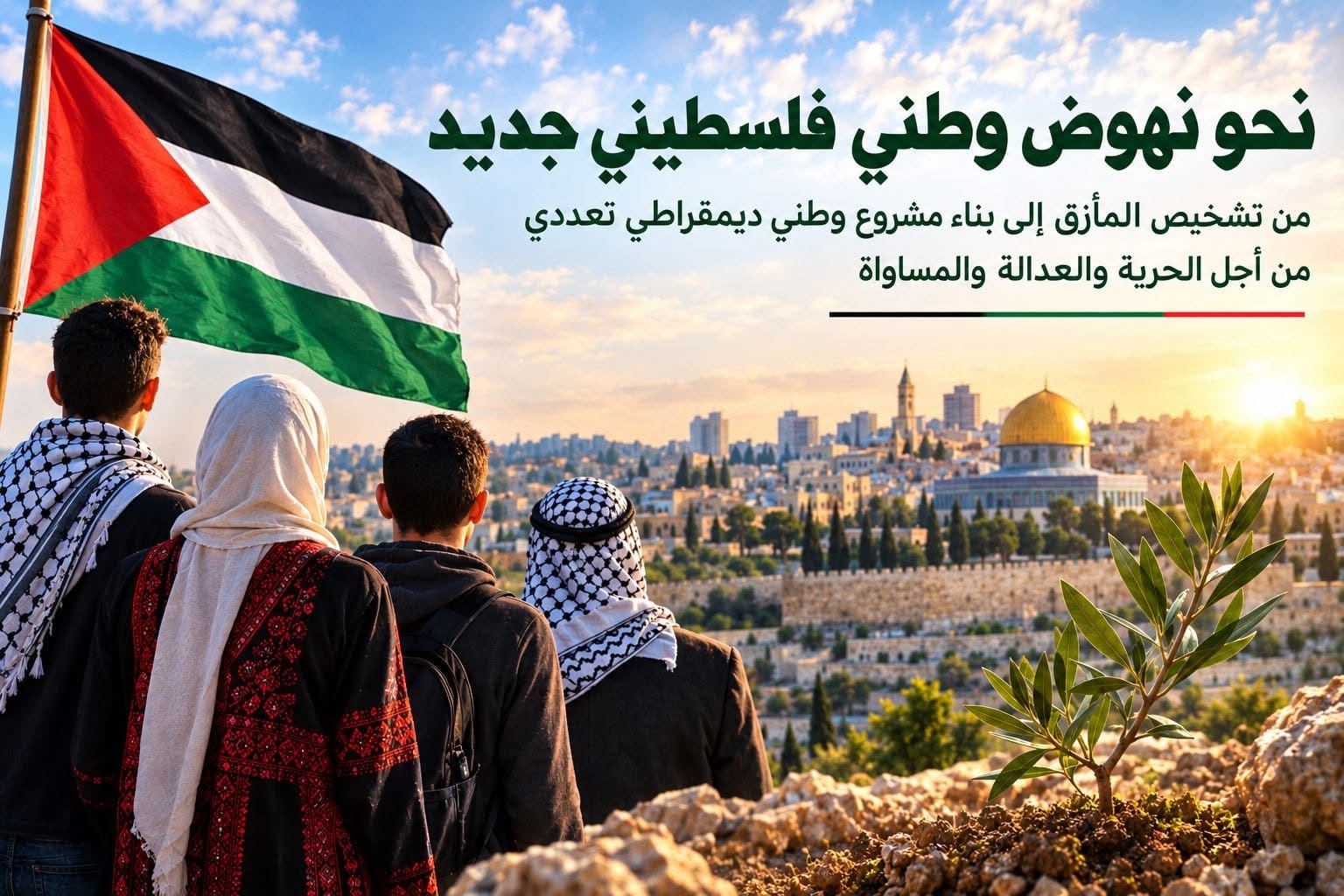

This is the intervention I delivered today at the conference “Prospects for Revitalizing the Palestinian Condition in the Face of Current Challenges,” organized by the Masarat Center and attended by hundreds of participants from the West Bank and Gaza, both in person and via Zoom.
If we are to answer the question posed by the conference, we must first answer another: Is there any prospect of revitalizing the Palestinian national condition under the existing political tools? If the answer, as I believe, is no, then what is required to make such a revival possible?
A short intervention cannot do justice to this central and fateful issue, but it can offer some signposts that may help point the way toward the answers we need.
Diagnosing the Palestinian Condition
The first task is to properly diagnose the Palestinian condition. Any objective assessment leads to the conclusion that there is a comprehensive structural crisis, manifested in two fundamental ways:
First, the Palestinian political system in all its components, the national movement, and civil society are unable to effectively confront, even at a minimum level, the existential challenges and dangers facing the Palestinian people, or to capitalize on the opportunities available to them.
Second, the Zionist colonial project has reached an unprecedented level of danger, moving toward a decisive push for annihilation, annexation, displacement, and the imposition of sovereignty, as part of a process aimed at eradicating the Palestinian cause at its roots, in all its national, political, and humanitarian dimensions.
The political system in all its components, the national movement, and civil society are experiencing a deep, structural, and comprehensive crisis as a result of the absence of renewal, review, and accountability, compounded by a buildup of interconnected and overlapping internal and external crises, local, regional, and international. This has resulted in an inability to effectively confront existential challenges and dangers, to the point that Palestinians have often become spectators rather than actors, watching plans to eradicate the Palestinian cause at its roots unfold before their eyes, particularly with regard to the refugee issue, Jerusalem, and Palestinians inside Israel, as well as attempts to resettle refugees outside Palestine.
The political system is also acquiescing to attempts to distort the historical narrative, including changes to educational curricula and the transformation of the issue of salaries for prisoners and the families of martyrs from a national and struggle-related cause, deeply connected to Palestinian memory and identity, into nothing more than a social issue.
It also waits for the genocide and displacement to stop, while watching Gaza become separated from the rest of Palestine and fall under foreign tutelage. It not only fails to take effective action to thwart this process, but, whether at the leadership or factional level, provides it with a degree of political cover and legitimacy by accepting it and acquiescing to the fait accompli.
In the West Bank, annexation, Judaization, settlement expansion, apartheid, and ethnic cleansing continue, transforming Palestinian areas into isolated population enclaves, exposed to attacks in their various forms, without any effective Palestinian capacity to stop them.
At the same time, amid the existing balance of power, the political system is, to varying degrees, aligning itself with the American and Israeli conditions, backed by international circles, for implementing what is referred to as “reform.” This reform may, in some respects, be a right pursued for the wrong ends, and in others, a wrong pursued for the wrong ends. The reform demanded from outside is not aimed at improving the performance of the Palestinian Authority; rather, it seeks to produce a “renewed” authority deemed acceptable and capable of becoming an actor in shaping the contours of Palestine’s future, without any guarantee that it will secure even the minimum of Palestinian national rights and interests.
The political and geographic divide, as well as the institutional split, continues and deepens despite the existential dangers facing the Palestinian people. National institutions continue to be marginalized and hollowed out, foremost among them the Palestine Liberation Organization (PLO), reducing it to an institution subordinate to an individual and a single political faction. This is gradually stripping it of its representative character as the inclusive national framework and the sole legitimate representative of the Palestinian people.
The erosion of militant, representative, and electoral legitimacy also continues. When steps were recently taken toward elections, they were undertaken in an improvised and unilateral manner, leaving them vulnerable to postponement or obstruction. Even if elections are held, conducting them without making them part of a comprehensive national vision could serve to entrench the existing reality and deepen fragmentation and division, a reality in which the Palestinian Authority has gradually become an administration of the population under occupation.
Adherence to the Oslo process continues to define the ceiling of Palestinian leadership’s political horizons, despite Israeli governments having abandoned most of their commitments under it long ago. At the same time, illusions and losing bets, wishful thinking, and factional projects that either submit to reality or recklessly challenge it continue to prevail, without serious review or any genuine effort to draw lessons from past experience.
All of the above indicates that the existing Palestinian tools have become incapable of generating the required revival. This makes it imperative to search for new forms and frameworks, whether by reforming, renewing, and transforming existing structures, or by establishing new frameworks, movements, and parties that seek to convene a constituent assembly tasked with laying the foundations for the next phase of Palestinian national revival.
Now that the crisis has deepened to this extent, the path forward requires more than a “third current” capable of breaking the sharp binary polarization that has characterized the past two decades. The scale of the existential dangers calls for the building of a national rescue front that brings together every patriot and everyone committed to the Palestinian people and their national cause.
A rescue front broad enough to include everyone who wishes to participate, without exclusion, treason accusations, or excommunication; and without anyone claiming a monopoly on truth, patriotism, or religion.
Any new initiative must begin with the recognition that the Zionist colonial project targets the Palestinian people in all their diversity, across individuals, social classes, and political orientations, because it is a settler-colonial, racist, and displacement-driven project. It does not merely seek to seize and judaize the land and expel its inhabitants; it seeks to displace Palestinians from their homeland in order to establish a Jewish state based on national and religious privileges.
This reality makes what unites Palestinians far greater than what divides them. It also makes the possibility of uniting them within a broad and pluralistic national front, based on national principles, genuine partnership, and consensual democracy, and of forming a single national leadership, an objective possibility awaiting the political agency capable of bringing it into being.
Foundations and Principles for a New Beginning
The foundation of the new revival is to restore the national project to the center, based on the following elements:
The National Charter
There is a need to formulate a new and inclusive national charter that preserves the historical narrative and the fundamental rights and objectives, while taking into account changes, lessons learned, and new realities. It should be grounded in the unity of the cause, the land, and the people, and redefine national identity and political rights, including the rights to self-determination and return, as well as Jerusalem, justice, and equality, in a manner that accommodates the different needs and priorities of the various Palestinian communities, without relinquishing national rights or interests.
The National Program
A realistic, phased national program must be developed that balances the preservation of the Palestinian people’s historic rights with the requirements of the current stage and identifies achievable objectives for each phase.
The Strategy of Struggle
The tools of national action must be diversified, political, popular, military, legal, diplomatic, media-related, and others, with each tool employed according to its suitability for achieving national objectives and interests and its compatibility with the balance of power at each stage. This should be accompanied by an open and responsible discussion of the effectiveness, risks, and consequences of each tool.
The Ultimate Goal and Interim Objectives
A distinction must be made between the ultimate strategic goal, interim strategic objectives, and immediate objectives.
The ultimate goal, according to the vision presented here, is to end the settler-colonial project and dismantle the system of racial privilege, thereby opening the way for the establishment of a political system based on equality and justice for all inhabitants of Palestine.
The interim strategic objective is to realize the Palestinian people’s right to self-determination, which may include ending the occupation and establishing an independent Palestinian state on the 1967 borders.
Other interim and immediate objectives include: stopping genocide, displacement, siege, starvation, apartheid, and settlement expansion; protecting Jerusalem; rebuilding Gaza; ending the division; securing the release of prisoners; building an economy of resilience and genuine development; and confronting attempts to distort history and the Palestinian national narrative.
The Priority of Resilience and Survival
The current stage is a stage of resilience and survival, not a stage of solutions, and it requires:
Stopping the genocide and plans for annexation, displacement, apartheid, and ethnic cleansing, while making reconstruction the highest of all priorities and strengthening the social and economic foundations of the Palestinian people wherever they live.
Protecting what remains of the gains already achieved, foremost among them the Palestinian presence on the land, national institutions, and the place of the Palestinian cause in international consciousness.
Defeating plans to divide and fragment Palestinian territory, confine people to isolated enclaves, and pursue displacement, annexation, and the political liquidation of the Palestinian cause through popular, diplomatic, legal, and media action.
Avoiding adventures that exceed available capabilities, as well as negotiations without binding reference points and without possessing the necessary leverage and the appropriate regional and international environment.
Avoiding engagement in partial solutions that sacrifice rights and drain national energy to no avail, until the balance of power changes and objective conditions emerge for moving into a stage of solutions.
The Place of the PLO, the Palestinian Authority, and the Factions
The Palestine Liberation Organization
The question of whether the Palestine Liberation Organization can be reformed and renewed from within should be resolved by rebuilding its institutions as a representative framework encompassing all Palestinians inside Palestine and in the diaspora. This would restore its status as the “sole legitimate representative” on the basis of genuine rather than merely formal participation.
If it becomes clear, and increasingly so, that the organization has become a factional and exclusionary institution, alternatives should be considered, including preparations for convening a constituent assembly capable of laying the foundations for a new national framework.
This process should not necessarily begin by stripping the existing leadership and organization of their legitimacy. Rather, it can begin by recognizing that the existing legitimacy is not sufficient and by working to build a new national legitimacy grounded in broad popular support, democratic representation, and national partnership.
The Palestinian Authority
The debate over the existence, function, and future of the Palestinian Authority must be resolved:
Should it remain an administrative and service-delivery instrument constrained by the Oslo Accords, and even more constrained by the practices of the occupation?
Or should its role be redefined and transformed within a comprehensive national strategy that goes beyond administering limited self-rule and managing a population under occupation?
Or do circumstances call for its dissolution and the establishment of a new authority or authorities?
This debate cannot be resolved without acknowledging that the occupation will not allow the Authority’s function to be changed unless it is compelled to do so by a shift in the balance of power and by political, popular, and international pressure.
The Factions
Every possibility for reforming and activating the factions should be exhausted, without harboring illusions about the likelihood of major change. The division must be brought to an end through genuine political partnership, rather than merely an administrative reconciliation, and the principle of pluralism within a unified national framework must be restored in place of the current duality in authority, representation, and leadership.
At the same time, there should be openness to, and encouragement of, the formation of new democratic and pluralistic national factions, movements, and currents, thereby creating space for the renewal of Palestinian political life.
The Steps Required
If we are to identify the practical steps required, they can be outlined as follows:
First: Make the resilience and survival of the Palestinian people and their cause the overriding priority.
Second: Place faith first in the people and their willingness to continue the struggle, and second in the Arab, Islamic, and humanitarian dimensions that support Palestinian rights and are engaged in the global struggle for freedom, justice, and equality.
Third: Change course and build a democratic and pluralistic national alternative.
Fourth: Develop a unified national position on elections and identify the requirements for ensuring their integrity and freedom and respecting their results, while emphasizing the need for international guarantees that exert pressure on the occupying state to prevent it from banning, obstructing, or nullifying the results of elections.
Fifth: Build a broad, democratic, and pluralistic national front, open to the widest possible range of forces, institutions, and individuals, and based on popular participation and initiative rather than on factions and elites alone.
This front should not content itself with opposition. It must offer practical models and alternatives in politics, the economy, public services, development, society, and culture.
Any renewed or newly established national movement should seek to achieve unity and national rescue while addressing people’s everyday needs, because the dangers facing the Palestinian people and their cause have become existential. It should define ultimate strategic objectives as well as immediate objectives that address the tasks of the present stage and can realistically be achieved.
Therefore, such a movement should not justify the existing reality or adapt to it on the assumption that “things cannot be improved beyond what they already are,” nor is it enough simply to preach about what could and should be.
What is required is to engage directly in the battles of the present without severing them from the future and its goals; to build on a national choice that is realistic, revolutionary, democratic, and consensual all at once, a choice that recognizes reality and engages with it in order to change it, without submitting to it and without trying to leap over it.