

If the expectations prove accurate, according to informed sources, the President is expected to issue today a decree calling for legislative elections to be held on Saturday, November 28, while setting the date for presidential elections at a later stage. The decree would reportedly include increasing women’s representation and lowering the voting age,both positive measures, as well as two major amendments: increasing the number of members of the Legislative Council to 200 and lowering the electoral threshold to 1%.
Mr. Hani Al-Masri argues that although these amendments may appear technical, they carry profound political implications. In his view, they would dilute electoral outcomes and strengthen the local and personal nature of electoral competition at the expense of political and programmatic rivalry, particularly with the continued requirement of political loyalty as a condition for candidacy. This, he believes, limits pluralism and transforms competition into a struggle over positions, influence, and interests rather than a contest between visions and political programs. He also notes that such changes would increase the financial cost of elections, especially when compared with the costs of holding simultaneous versus separate elections, and of electing 200 members instead of 132.
Al-Masri notes that these developments come at a time when calls are growing to postpone elections until March, allowing for greater clarity regarding the outcomes of the US and Israeli elections, the nature of the next Israeli government, and the trajectory of US-Iranian understandings and their regional implications. He adds that demands are also increasing from civil society,particularly human rights organizations,and from most political factions to hold presidential and legislative elections simultaneously. He further points out that prominent figures within Fatah have called for beginning with presidential elections, which would require agreement on a candidate in light of President Mahmoud Abbas’s age and the possibility that he may not run, following a national dialogue that leads to consensus on a national roadmap.
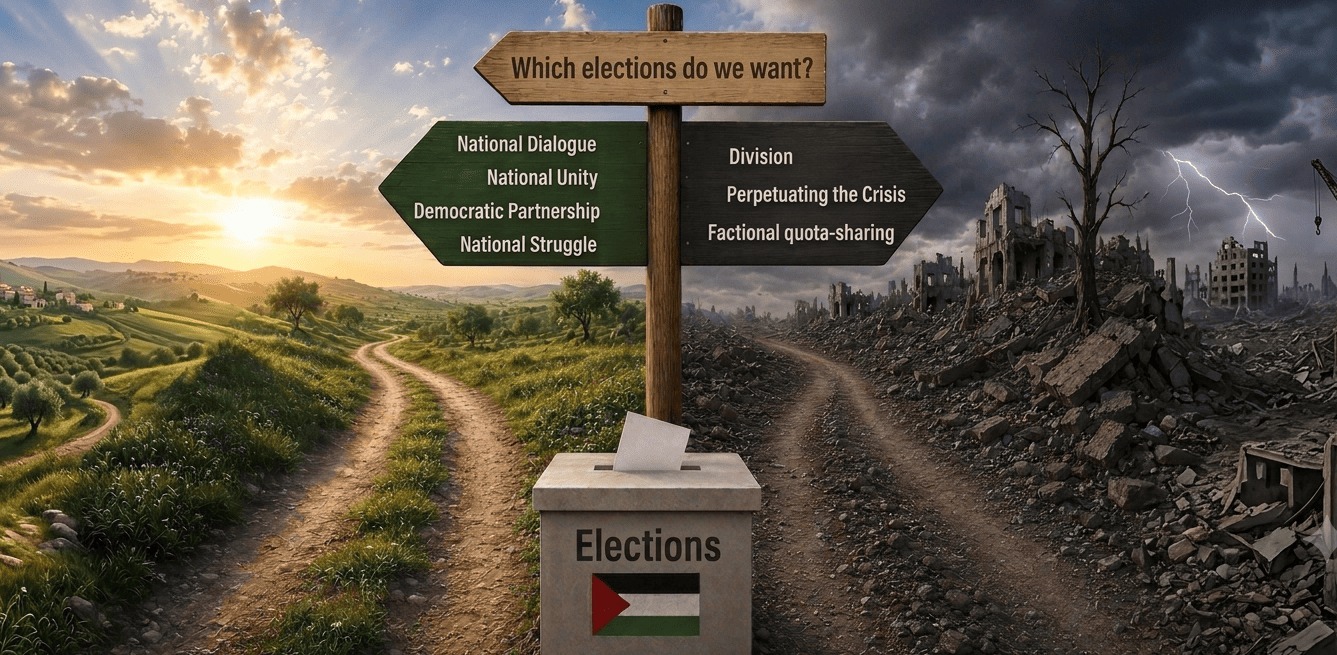
However, Al-Masri emphasizes that the real question is not *when* elections should be held, nor even *whether* they should take place, but rather: **What kind of elections do we want? And what national project will they serve? Will they represent a step toward rescuing the Palestinian cause, or will they become a tool for reproducing and entrenching the crisis under even more dangerous circumstances?**
He stresses that the Palestinian cause is currently facing an unprecedented existential crossroads. Amid the continuation of the war of extermination and displacement, the acceleration of annexation and the imposition of sovereignty, and attempts to reshape the Palestinian reality in all its dimensions,as well as the wider regional landscape,the issue is no longer limited to the future of the Palestinian Authority, the presidency, the Legislative Council, or even the Palestine Liberation Organization. Rather, it concerns the future of Palestine itself: **Will it remain a national liberation cause of a people struggling for self-determination, or will it be reduced to a matter of managing a population through local authorities or administrations under occupation?**
According to Al-Masri, the risks facing Palestinians do not target only the leadership, government, Authority, PLO, factions, or resistance movements, but also the collective Palestinian national identity, the unity of the people, land, and cause, and the representative role of the PLO. He warns that the Palestinian Authority could ultimately face two equally difficult choices: either being transformed further into a limited civil administration whose role is to manage the population under occupation, or being bypassed and replaced by fragmented local authorities and administrations, or by expanding the model of a technocratic committee operating under what is referred to as the “Peace Council,” which has already bypassed the leadership, the Authority, and factions in reaching the West Bank.
For this reason, Al-Masri argues that elections cannot be viewed separately from the political context in which they are being held. They come at a moment when the objectives of the war intersect with projects aimed at reshaping the Palestinian political system and the region as a whole. Therefore, he says, the criteria for evaluating these elections should not be limited to their integrity or timing, but rather whether they contribute to advancing this trajectory or form part of a national strategy to prevent and confront it.
He further explains that recent regional developments and international shifts resulting from the collapse of the old international order and the emergence of a more multipolar system require a new reading of realities. Al-Masri argues that the US-Israeli confrontation with Iran has not achieved its declared objectives and has instead opened the door to new balances that are still taking shape. This, he says, requires Palestinians to better understand these transformations and build their policies accordingly, rather than remaining dependent on regional and international equations that may already be changing.
From this perspective, Al-Masri stresses that elections are not the solution, nor are they the entry point to a solution. However, they could become part of a solution if preceded by a deeper political and national process beginning with a different kind of national dialogue,one that moves beyond previous experiences and focuses on reaching agreement over a unified national vision defining the nature of the current phase, national objectives, guiding principles and values, appropriate forms of struggle, and the foundations of national partnership away from factional quotas. He calls for agreement on a realistic minimum national program that does not compromise the ultimate goals and fundamental rights of the Palestinian people.
Before any elections, he argues, there must be agreement on the foundational principles governing Palestinian political life, including a renewed formulation of the National Charter that responds to new realities and lessons learned while preserving fundamental rights. These include the unity of the cause, the unity of the people, the unity of the land, the historical narrative, and the Palestinian people’s right to return, self-determination, and to live in freedom and dignity. This should also include agreement on democratic and national partnership rules that prevent monopolization, exclusion, and factional quota-sharing.
Al-Masri warns that proceeding toward elections amid the restructuring of the Palestinian people and their political system, the continuation of division, the absence of unified national leadership, unilateral preparations, restrictions on candidacy, and the formulation of electoral rules designed to guarantee predetermined outcomes will only deepen the crisis. Even if election results contradict expectations, he argues, the occupation possesses the tools to prevent or obstruct elections or confiscate their outcomes, as occurred following the 2006 elections.
He emphasizes that the objective is neither to postpone elections indefinitely nor to reject them in principle, but rather to place them in their proper context: as a means to strengthen national unity, renew legitimacy, build institutions, and serve the national project,not as an end in themselves, nor as a mechanism for reproducing division or consolidating an even worse status quo.
Al-Masri concludes that there is still time to change course. A serious national dialogue based on partnership rather than quotas, and grounded in the National Charter and a shared minimum program rather than temporary compromises, could pave the way for a new Palestinian strategy capable of confronting challenges, seizing opportunities, and unifying national efforts.
He warns that time is running out, Palestinian blood continues to be shed every day, and history will judge harshly those who waste opportunities for national rescue and fail to act. In his view, the destructive trajectory can still be halted if Palestinians possess the political will to immediately begin a new national dialogue leading to a unified roadmap and making elections part of the broader struggle for national liberation, not merely another stage in consolidating and managing the crisis, or, worse still, reaching a far more dangerous situation.