
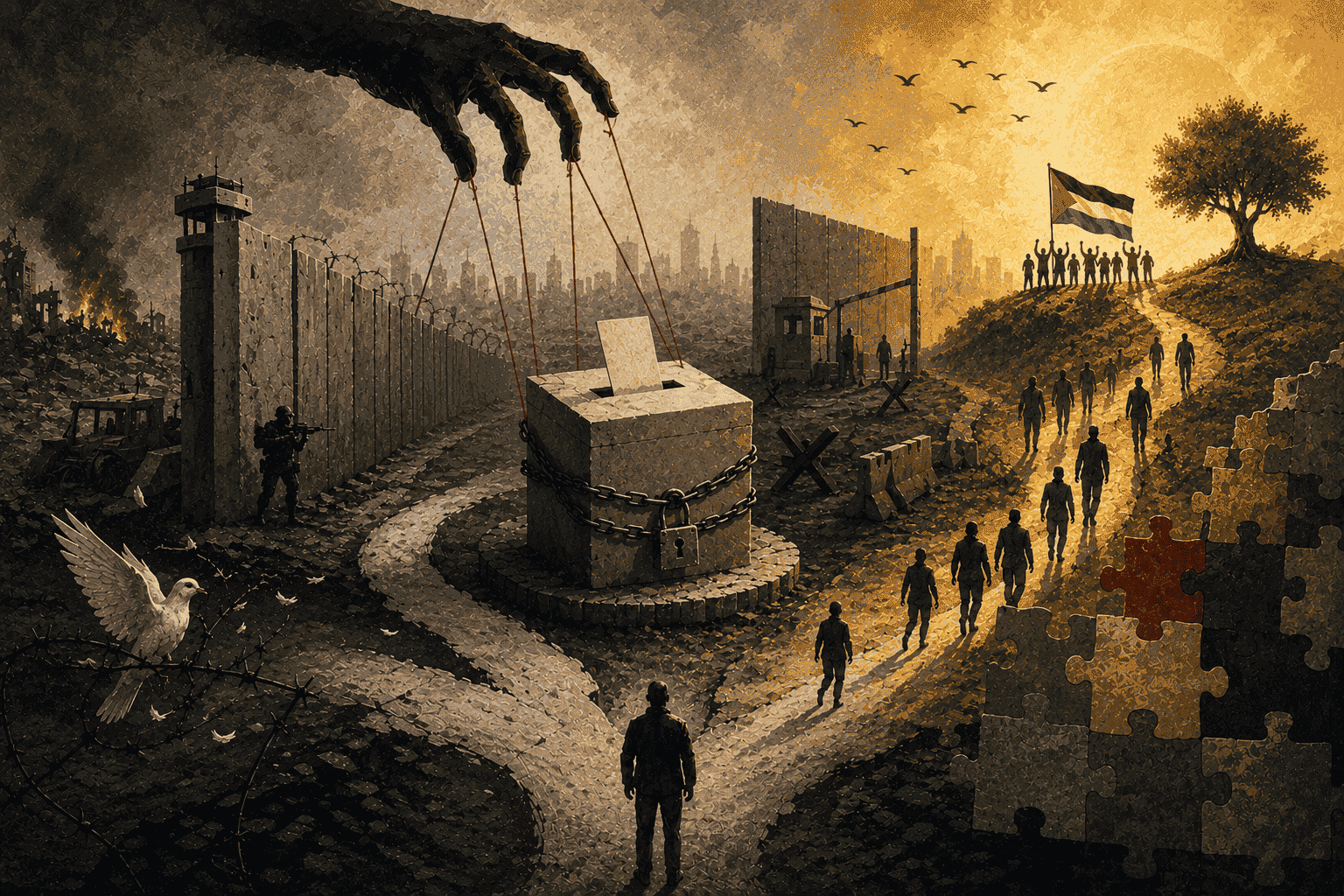

Although I agree with many of the ideas you put forward, I do not support participating in the elections under the current circumstances. Such participation could end up legitimizing a process that distorts the will of the Palestinian people and leads us to an outcome even worse than Oslo.
There are, in my view, only a few likely scenarios. Israel may prevent the elections from taking place altogether, unwilling to grant legitimacy even to the Palestinian Authority, which,despite its limitations,still embodies Palestinian national identity at a time when Israel is attempting to eliminate the Palestinian cause in all its dimensions. This could happen directly or indirectly by preventing voting in Jerusalem, Area C, and perhaps Gaza as well, or through measures such as escalating military aggression and genocide.
Alternatively, the Palestinian Authority may once again postpone or cancel the elections, as it did in 2021, if it concludes that it is likely to lose. It is well aware, or will soon realize, that the current political climate is deeply unfavorable. The widening gap between the Authority and the Palestinian public, the failure of its political program, the persistence of internal division, the growing emergence of alternative forms of guardianship and representation, the continued Israeli campaign of genocide and forced displacement in Gaza, annexation, the imposition of Israeli sovereignty, settlement expansion, escalating attacks by settlers and the Israeli army in the West Bank, rising unemployment, deteriorating living standards, years of half-paid public-sector salaries, recurring crises involving corruption, fuel, and border crossings, together with the fallout from Fatah's Eighth Congress, all contribute to this reality. Or the elections may simply be conducted in a manner where the outcome is predetermined, a point that hardly needs spelling out.
Under these circumstances, I see no realistic prospect for free and fair elections whose results would actually be respected, even though demanding elections remains necessary. And if elections are held, their results are likely to be disregarded if they fail to produce the desired outcome.
Nor can today's situation be compared to the 1996 elections. Those elections took place without genuine competition, and Israel allowed them because they conferred legitimacy on the limited self-governing authority created under the Oslo Accords,an authority whose powers have since been steadily eroded. We should also recall the fate of the mayors elected in 1976, many of whom were targeted through assassination attempts, expulsion, or replacement by appointed municipal councils. Likewise, the results of the 2006 elections were effectively nullified after Israel permitted them under the assumption that Hamas could be contained and incorporated into the Oslo framework, consistent with a broader American policy of promoting "moderate Islam" against "extremist Islam" and the belief that Hamas would not secure a majority. The 2021 elections, meanwhile, were postponed out of fear of defeat.
Today's circumstances are considerably worse. Israel is governed by its most extreme coalition since the state's establishment, and it is itself entering an electoral period, encouraging even more radical policies in an effort to reverse declining poll numbers and improve its electoral prospects,or perhaps even postpone its own elections should war or major developments occur. A Netanyahu–Ben Gvir–Smotrich government will not permit elections that could strengthen Palestinian society or contribute to Palestinian unity. Instead of preparing strategies to confront this reality, valuable time is being wasted on elections that come at the wrong moment, before addressing the more fundamental priority: reaching agreement on a new political and social compact that should precede elections and indeed any other political process.
Compounding this is a clear Israeli-American effort,which has not been met with sufficient official Palestinian, Arab, regional, or international opposition,to exclude the resistance factions from participating. Such exclusion strikes at the very heart of any democratic process. Regrettably, many have begun treating this as an unavoidable practical reality. If these factions do contest the elections, their candidates will almost certainly face arrest or assassination before or after polling day.
The presidential election remains even more uncertain. It depends on the outcome of the legislative elections. Should the Authority lose, the presidential election is unlikely to take place. It also hinges on resolving the question of Marwan Barghouti's candidacy, given that the imprisoned leader is widely regarded as the strongest potential candidate unless prevented from running.
Moreover, excluding the resistance factions from competition would strip the elections of much of their political and programmatic character, strengthening localism instead. The contest would increasingly revolve around individuals, power brokers, business interests, families, clans, and fragmented communities separated by checkpoints, gates, settlements, bypass roads, military zones, and the violence of settlers and occupation forces, all competing for influence and control. This could inadvertently benefit personalities close to the resistance factions. Furthermore, imposing political loyalty requirements could later be used as a legal instrument against anyone deemed to have violated pledges to uphold the PLO's political program or international legitimacy. At the same time, appointments to the Palestinian National Council continue to replace elections to an even greater extent than in the past.
Even if, for the sake of argument, elections are held and nationally committed democratic figures emerge victorious, Israel would simply nullify the results, as it has done before.
For these reasons, I believe the wiser course is to prioritize developing and implementing national strategies aimed at stopping genocide, forced displacement, ethnic cleansing, annexation, and the imposition of Israeli sovereignty; ensuring humanitarian relief and launching reconstruction in Gaza; strengthening the resilience of Palestinians throughout the West Bank, Gaza, and inside Israel; preserving what remains of Palestinian institutions and national achievements; and thwarting attempts to eliminate the Palestinian cause.
At the same time, efforts should continue toward articulating a comprehensive national vision, developing appropriate strategies, adopting an inclusive national program, and achieving genuine national consensus based on democratic partnership. Such a framework should bring together all national and democratic forces and institutions around a shared agenda capable of confronting current threats while making the most of available opportunities. It could pave the way for both political and institutional unity and strengthen the Palestinian position regardless of whether elections ultimately take place.
Participation in elections should therefore be conditioned on the existence of minimum guarantees ensuring their integrity and the respect of their results, backed by regional and international guarantees. If these conditions are absent, then a boycott becomes a political obligation aimed at denying the electoral process and its outcomes both popular legitimacy and national credibility, rather than granting them additional legitimacy.
Those who nonetheless advocate participation generally do so as a form of political objection,viewing elections as an act of resistance against Israel's attempts to impose its conditions and dictate outcomes to the official Palestinian leadership and the Palestinian Authority through a process that falsifies the will of the Palestinian people, or alternatively perpetuates an intolerable status quo. Under more favorable circumstances, and provided there are at least minimal guarantees of fairness, participation could serve to prevent leaving the political arena uncontested and avoid granting the electoral process automatic legitimacy.
Although I have contributed to efforts to build the broadest possible national democratic front for political and democratic struggle, both before and after the elections, and have advocated the formation of a broad national electoral list capable of winning, together with the nomination of Marwan Barghouti for the presidency, I believe the chances of achieving this remain limited and require sustained effort to expand. I suspect you share this assessment. Personal and factional interests, the dominance of individual egos, competition over candidate rankings, and interference by Israel, the Palestinian Authority, and regional and international actors through inducements and intimidation all threaten to undermine this important objective.
Nevertheless, hope remains alive. The Palestinian people will ultimately find their path to liberation, sooner or later, as they have done throughout their history. They will do so again,especially if they find the leadership they deserve. Despite immense suffering, sacrifice, and repeated catastrophes, they have never raised the white flag. Their cause remains just, morally compelling, and today more than ever stands as a symbol of freedom for free people across the world.