
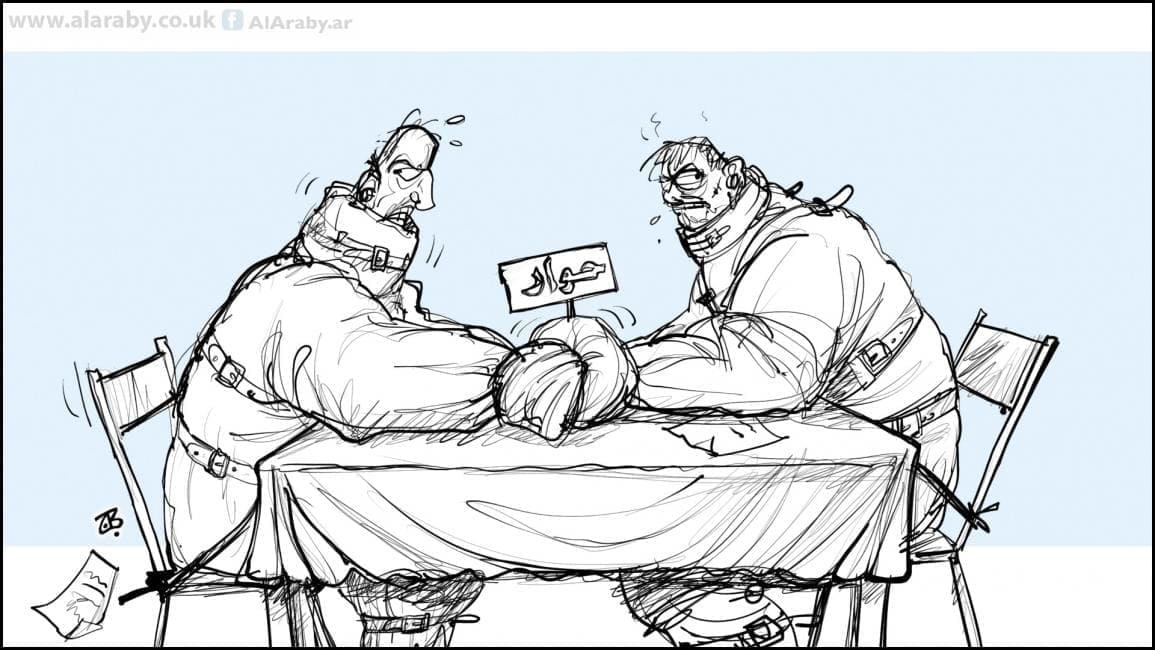

The postponement of the elections and its repercussions have largely captured the attention of the Palestinian political elite. Yet Palestinians living in their homeland are far less concerned with whether elections are held or postponed, as they struggle with more immediate priorities: staying alive, putting food on the table, protecting their homes, securing their safety, accessing healthcare and medicine, finding work, and confronting genocide, annexation, displacement, settlement expansion, and settler attacks.
A poll conducted by the Palestinian Center for Policy and Survey Research (ORAD) found that 66% of Palestinians in the Gaza Strip and 55% in the West Bank did not know when the elections were scheduled to take place.
If the national dialogue also fails, as Al-Masri expects it will if it merely reproduces previous rounds of talks and agreements, another nail, perhaps the final one, will be driven into the coffin of the Palestinian political system in all its components. This would further erode its legitimacy and credibility, widen the gap between the leadership and the public, and invite greater external pressure and intervention, particularly from donor countries. Such developments could pave the way for a return to external tutelage and the extension of the “Board of Peace” model to the West Bank.
Some of these actors, including the European Union and France in particular, have threatened to suspend aid unless the decisions to postpone the elections are reconsidered. Yet, Al-Masri argues, they have failed to adequately address the occupation’s efforts to impose obstacles that make free elections impossible.
Against this backdrop, proposals have emerged to establish a parallel framework to the Palestine Liberation Organization (PLO) before rebuilding its institutions. Other proposals call on donors to supplement their demand for elections with the formation of an empowered government led by a prime minister with full executive authority, reducing the president to a ceremonial role.
Al-Masri considers such a proposal potentially beneficial if it emerges as an initiative of the Palestinian people and Palestinian political actors themselves. However, he warns, it becomes dangerous and loses its national character if it relies on external powers to impose change.
Elections Postponed for Fear of Defeat
Al-Masri argues that the postponement was driven primarily by the ruling leadership and political elite's fear of losing power. Several indicators and opinion polls, including some that were conducted but never published, suggested that they would secure, at best, 24% of the seats and, at worst, fewer than 10%.
Such an outcome would fundamentally reshape the Palestinian political landscape, translating into political terms the developments that have taken place and reflecting the realities that have emerged since October 7.
The emerging political landscape, Al-Masri argues, is also expected to reflect, and accommodate, the realities Israel is creating daily in the West Bank, where its plan to impose a decisive outcome to the conflict is being implemented at an accelerating pace.
A New Political Landscape Takes Shape
The outlines of this new landscape have already emerged from what Al-Masri describes as a new Nakba, particularly in Gaza. Despite the widely celebrated narrative of steadfastness and heroic resistance, the confrontation ended, in his assessment, with the acceptance of Trump's plan, which subsequently became UN Security Council Resolution 2803.
He attributes this outcome to the imbalance of power, the regional and international environment, miscalculations, and the urgent desire to halt the genocidal war. Yet the plan, he argues, amounts to a form of external tutelage over the Gaza Strip.
The Palestinian side implemented most of its commitments under the first phase and reaffirmed its willingness to fulfill the remaining obligations. These included Hamas relinquishing power, disarming, and transforming itself into a political party, as set out in an agreement with the “Board of Peace” at the end of July. Israel, by contrast, failed to implement most of its commitments under the first phase and rejected the agreement in question.
The emerging political landscape is also intended to accommodate the realities Israel is imposing daily in the West Bank. Al-Masri describes an accelerating campaign to impose a decisive outcome to the conflict and eliminate the Palestinian cause at its roots.
He identifies several elements of this strategy: continued genocide and displacement, the liquidation of the refugee question, preventing the establishment of a Palestinian state, undermining the Palestinian Authority, impoverishing the population, giving settlers greater freedom to act, advancing gradual annexation, expanding existing settlements and establishing new outposts, and entrenching apartheid.
He also points to the forced internal displacement of Palestinians into isolated enclaves in Areas A and B, alongside efforts to empty Area C, with the aim of eventually displacing Palestinians abroad when circumstances permit, after annexing, settling, and Judaizing as much land as possible.
Lessons from the First and Second Intifadas
Al-Masri argues that the current developments are not without precedent. Similar patterns emerged after the First and Second Intifadas, when major achievements were followed by serious setbacks.
The First Intifada initially secured significant gains, but these were subsequently undermined by the collapse of the Soviet Union, the breakdown of Arab solidarity following Iraq's invasion of Kuwait, and the drying up of the PLO's financial resources. Al-Masri also attributes the reversal to one side's failure to capitalize on the gains achieved and another's rush to reap the rewards before they had matured.
These developments, he argues, help explain the Palestinian leadership's entrapment in the Oslo process, a major setback resulting from damaging illusions and failed bets.
The Second Intifada followed what Al-Masri describes as a trap set by Israeli Prime Minister Ehud Barak for Yasser Arafat. Barak sought to move directly to final-status negotiations by merging the obligations of the interim and final-status phases. US President Bill Clinton then invited Arafat to the Camp David summit under the pretext of reaching a peace agreement.
According to Al-Masri, however, Barak's actual objective, as he himself stated, was to expose Arafat and reveal his true face. Barak subsequently blamed the Palestinians for the summit's failure, contrary to his earlier assurances.
The Second Intifada erupted following Ariel Sharon's provocative visit to the Al-Aqsa Mosque compound, amid a calculation that proved mistaken: that a limited armed uprising could be contained and would improve Palestinian negotiating leverage.
The September 11, 2001 attacks then prompted a major shift in US and international policy against resistance movements, increasingly associating resistance with terrorism. This opened the door to demands for a change in Palestinian leadership and the installation of a new leadership committed to fighting terrorism, as reflected in George W. Bush's June 2002 speech.
The subsequent Road Map for Peace was undermined by Sharon, who attached 14 reservations to it. Israel also advanced its disengagement plan for Gaza.
In parallel, proposals emerged to “reform” the Palestinian Authority by creating the position of prime minister and transferring powers from the president to the new office. Al-Masri describes this as a case of “a legitimate principle being used to serve an illegitimate purpose”: weakening Arafat's leadership and installing a leadership more responsive to American and Israeli demands.
Despite the emergence of such leadership, Israel's position did not improve. Instead, it became more hardline, even as the Palestinians made further concessions.
“Reforming” the Palestinian Authority Once Again
Al-Masri sees today's developments as another chapter in this recurring pattern, unfolding under even less favorable Palestinian circumstances and under a familiar, renewed banner: “reforming the Palestinian Authority” or creating a “renewed Palestinian Authority.”
Elections are among the instruments being used to advance this agenda, even as genocide, annexation, settlement expansion, and apartheid continue, and both the Palestinian Authority and resistance movements have suffered severe blows. These setbacks have substantially weakened both and created a vacuum that others are preparing to fill.
Al-Masri argues that ending the genocide has increasingly been tied to demands for Hamas to relinquish power, the disarmament of Gaza, and Hamas's exclusion from the future Palestinian political system, including a refusal to allow it to participate in elections. He stresses that these demands are not coming from Israel and the United States alone, but also from regional and international actors.
In his view, the Palestinian national dialogue in Cairo is essential not only to resisting this agenda, but also to improving the terms under which Palestinians confront it.
Success requires a national consensus that goes beyond agreeing to hold elections as soon as possible. It must also address the need to redefine the Palestinian national project or, at the very least, agree on a political program capable of confronting the existential threats facing the Palestinian cause, land, people, rights, and the PLO's status as the sole representative of the Palestinian people.
Such an outcome, Al-Masri argues, requires a clear understanding of both the risks and the opportunities, without exaggerating either or underestimating their significance, and a political will that places unity, pluralism, and partnership above all other considerations.
If these conditions are met, and the Palestinian people and their active social and political forces mobilize to assert their will, the dialogue may succeed this time.
That would require broadening participation to include representatives of women, young people, refugee communities and the diaspora, civil society, the private sector, and independent public figures. It would also require changing the agenda so that the dialogue does not simply reproduce factional power-sharing arrangements.
Instead, it should focus on developing a shared vision, a common strategy, inclusive partnership, pluralistic unity, and unified leadership. Its foremost objective must be to secure the conditions necessary for the Palestinian people and their cause to endure, while defeating the various components of the plan to eliminate the Palestinian cause.
Al-Masri also calls for renewed faith in the Palestinian people, whom he describes as “the camel that carries every burden,” the embodiment of steadfastness and survival, and a phoenix capable of rising from the ashes. He further emphasizes the importance of mobilizing Arab and Muslim societies, peoples around the world, and forces committed to freedom.
He points to what he considers an irreversible historical shift: the Palestinian cause has become a global symbol of freedom and justice, with the struggle for Palestine increasingly intertwined with movements for justice worldwide. It has even become a domestic political issue in Western countries.
A Narrow Opportunity Amid a Deepening Crisis
Al-Masri acknowledges that the prospects for a successful dialogue remain limited, given the profound impasse and severe weakness affecting every component of the Palestinian national movement.
Nevertheless, he sees an opportunity in the shared existential threat posed by genocide and in the fact that some of the major sources of Palestinian division have either disappeared from the ground or could be removed from the negotiating table.
The competition for power between two rival Palestinian authorities was one of the principal roots of the division. Today, the Palestinian Authority in Gaza has been destroyed, and Hamas has indicated its readiness to relinquish what remains of its authority. Meanwhile, the Palestinian Authority in the West Bank continues to be undermined.
Al-Masri outlines several possible futures for the Authority if it is not fundamentally transformed through a new political approach: its dissolution, its dismantling and replacement with local authorities, or its continued existence stripped of meaningful political or national substance, without a political horizon and confined to administering the population under occupation.
This raises a fundamental question about the purpose of elections: Are Palestinians electing someone to administer the prison and improve the conditions of captivity, perpetuating and deepening division, or someone committed to breaking the prison bars and achieving unity as the path to victory, ending the occupation, and realizing self-determination and independence?
As Al-Masri emphasizes, not all elections serve the same purpose.
He warns against abandoning the national, democratic, and social program or dismissing the experience of Palestinian factions altogether simply because their strategies have reached a dead end. The argument that immediate living conditions must take priority is valid, he acknowledges, but addressing those conditions alone would mean accepting coexistence with the occupation, submitting to its terms, and relying on donors and external actors.
The factions, he argues, became so weak precisely because they abandoned their national and democratic programs, grew outdated and stagnant, succumbed to corruption, and failed to renew or transform themselves. Their continued survival became an end in itself, leaving them resembling, in his words, “a community where everyone looks after their own interests.”
If electoral and political competition becomes a contest between individuals, without agreement on shared principles, objectives, or the basic rules of collective action, the result could be even worse than the present situation. Each individual would pursue personal interests, those of their family or clan, or the interests of the financial or security sector they represent.
From Disagreement over Strategy to a New Political Reality
Al-Masri notes that earlier Palestinian divisions centered on the proposed establishment of a Palestinian state. Today, he argues, there is broad national agreement on that objective.
There was also disagreement over the forms of struggle, particularly between those who supported negotiations and those who advocated armed resistance.
The Palestinians have now entered a different phase, he argues: one with no viable political solutions, no meaningful negotiations, and no political horizon for years to come. At the same time, the high cost of armed resistance and the regional and international environment have severely constrained the possibility of pursuing it.
As a result, a broad Palestinian consensus has emerged around halting armed resistance, despite its status as a legitimate right of any people living under occupation. Al-Masri points to the Palestinian acceptance of the Security Council resolution, based on Trump's plan and the agreement to implement it, as an indication of this shift.
Before an Entire Era Comes to an End
For Al-Masri, a path forward remains possible if there is the political will to undertake an honest reassessment, demand accountability, renew political thinking, and pursue meaningful change.
Without that will, he warns, the curtain may soon fall on an entire era of Palestinian history that began with the Nakba of 1948.
A period of retreat would follow, potentially lasting for years, but it would not bring the conflict to an end. Instead, a new era and a new wave of Palestinian struggle would eventually emerge.
Al-Masri expresses hope that this next phase will be different, and, above all, that it will produce different results.
The Palestinian people deserve victory, and they are worthy of it.
Note: This is not a literal, word by word translation of the original article. It is an English adaptation that conveys all of the original article’s ideas and follows its argument and sequence. Direct quotations are taken from the original article.