
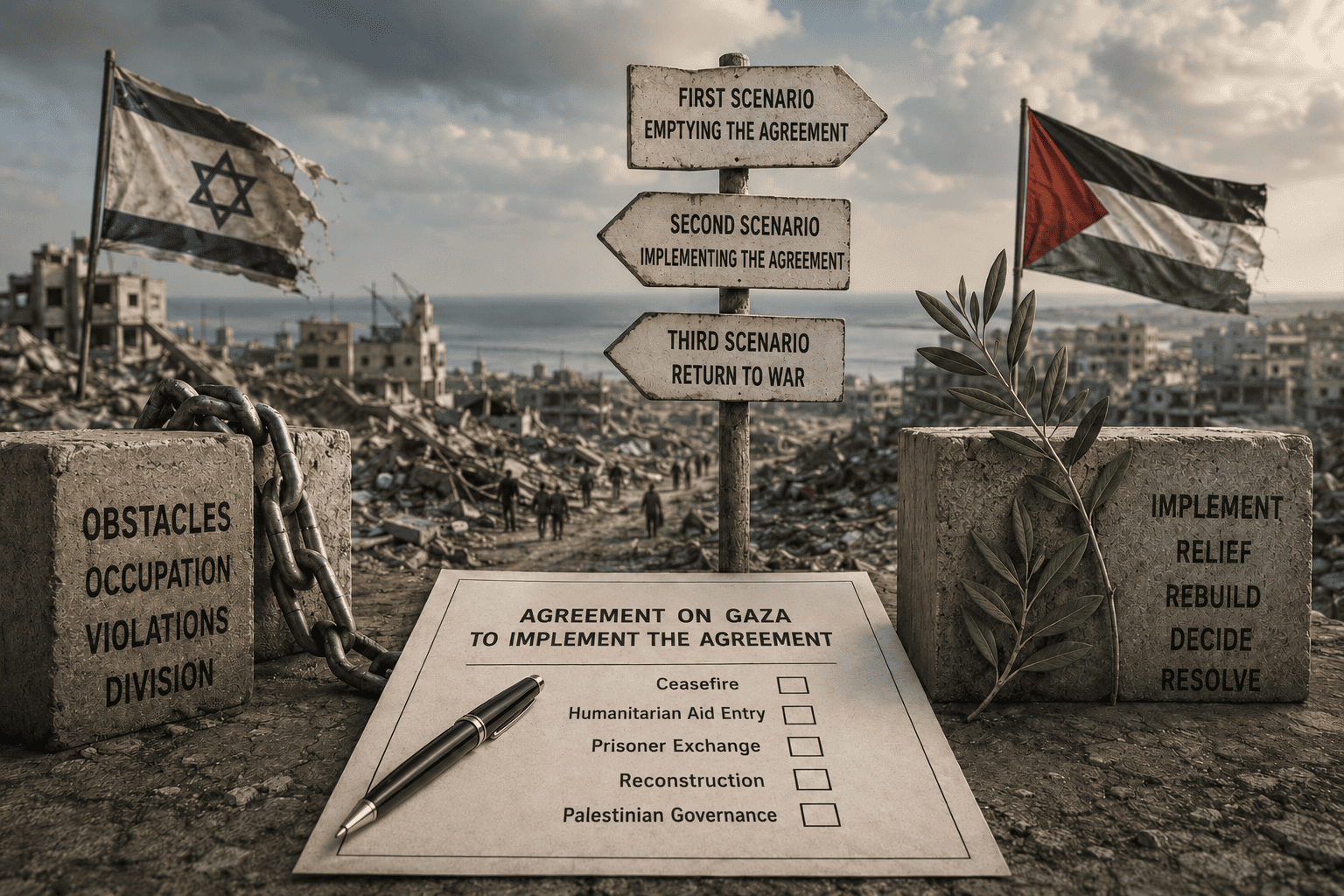

Hani Al-Masri argued that the recently announced Gaza agreement should not be viewed as a new deal, but rather as "an agreement to implement the agreement reached last October." He stressed that assessing its prospects requires looking at what happened to the original agreement.
Al-Masri noted that the previous agreement succeeded in halting the war of extermination and mass displacement, leading to the adoption of the U.S.-backed plan through UN Security Council Resolution 2803, as well as the establishment of the Peace Council and its affiliated Palestinian Administrative Committee. However, he pointed out that Israel has still not allowed the committee to enter Gaza.
According to Al-Masri, Hamas fulfilled its commitments under the ceasefire and prisoner exchange agreement and later dissolved its governmental emergency committee while expressing readiness to transfer Gaza's administration to the Palestinian Administrative Committee.
He emphasized that Hamas had demonstrated considerable flexibility, saying the movement had floated the idea of a long-term truce of up to fifteen years and gradually softened its position on weapons. He noted that its latest position was a willingness "to store its weapons and hand them over to the Palestinian Administrative Committee." He also observed that Hamas did not insist on completing all first-phase obligations before moving to the second phase, instead accepting parallel implementation once Israel took initial steps, particularly regarding humanitarian aid.
By contrast, Al-Masri argued that Israel failed to implement most of its first-phase obligations and instead prioritized the issue of weapons before everything else. He said Israel also failed to implement the humanitarian protocol, allowing only about one-third of the agreed aid into Gaza while tightly controlling movement in and out of the Strip. As a result, far fewer people than agreed were permitted to leave, including most wounded Palestinians requiring medical treatment,a policy he described as posing a direct threat to their lives.
He further argued that Israel simultaneously expanded its military presence, increasing its control over Gaza from 53% at the time of the ceasefire agreement to nearly 70%. During that period, he said, approximately 1,300 Palestinians were killed, around 3,500 injured, thousands of homes and facilities demolished, while military bases, sand berms, and concrete barriers were constructed, further fragmenting the territory. He also claimed Israel established a local militia tasked with spreading disorder and fueling internal divisions.
Al-Masri noted that several Israeli ministers, including the Minister of Defense, had openly declared their desire for the war, displacement, occupation, and settlement expansion to continue even if Gaza were completely disarmed.
He argued that Israel accepted the U.S. plan only reluctantly and under pressure from U.S. President Donald Trump. In his view, Trump sought to rescue Israel from the consequences of its government's policies after the war had severely damaged Israel's international standing, deepened its isolation, and undermined its political narrative.
Al-Masri maintained that had the campaign of mass destruction continued unabated, Israel would likely have faced severe international isolation and potentially sanctions from states, UN bodies, and international courts. He added that "the Palestinian cause has today become a global cause of freedom and justice," including inside the United States, where public opinion,particularly among younger Americans,has become increasingly sympathetic to Palestinian rights. He cited a recent poll indicating that 50% of Americans supported Netanyahu's arrest during his recent visit to the United States in accordance with the international arrest warrant issued against him.
Three Possible Scenarios
1. Formal Approval, Practical Sabotage
Al-Masri described the most likely scenario as one in which Israel formally accepts the agreement while emptying it of its substance through conditions and reservations. He likened this to former Israeli Prime Minister Ariel Sharon's approach to the Roadmap, recalling that Sharon accepted it while attaching fourteen reservations that effectively rendered it meaningless.
He suggested Israel could begin undermining the agreement even before its formal adoption, pointing to the deadly attacks carried out while expectations were building for a halt to assassinations and military assaults.
According to Al-Masri, Israel is expected to insist on the immediate destruction and surrender of weapons, reject the participation of Qatar, Turkey, or any country lacking a peace treaty with Israel in an international stabilization force, and demand that the Israeli military retain freedom of military operations even in areas where such a force is deployed.
He also argued that Israel may exploit the lengthy process required for the Palestinian Administrative Committee to assume governance, refusing to absorb many public employees because of alleged Hamas affiliations despite knowing that ignoring existing institutions would be "a recipe for failure."
Al-Masri added that Israel could benefit from insufficient international funding for the Peace Council, relief, and reconstruction efforts, as well as hesitation among countries considering participation in a stabilization force. While Israel reportedly wants such a force to enforce security according to its own vision, participating states, he noted, see their role as limited to peacekeeping.
He further predicted that Israel would resort to delay and procrastination, linking any gradual withdrawal to additional political and security demands.
Al-Masri concluded that this remains the most probable scenario, arguing that the Israeli government does not want to appear defeated ahead of elections by acknowledging that it failed to eliminate Hamas and other resistance factions. He also observed that the agreement itself requires guarantees that Hamas will not be targeted, allowing it to continue operating politically.
He further argued that since last October, the Trump administration has not exerted serious pressure to stop the gradual violations or fully implement the agreement. Instead, he said, Washington's priority has been preventing a return to full-scale war while preserving the appearance of progress through the Peace Council, even as Israel continued creating new facts on the ground.
2. Full Implementation of the Agreement
The second scenario assumes that the United States, and President Trump in particular,throws its full political weight behind implementing the agreement.
Al-Masri described this as possible but unlikely. He argued that Trump still needs Israel in the context of regional conflicts and his confrontation with Iran, while also relying on pro-Israel political support ahead of the U.S. midterm elections, at a time when his approval ratings have declined significantly.
Nevertheless, Al-Masri suggested that Trump's inability to secure decisive victories on Iran, Ukraine, or the economy could motivate him to protect what he considers an achievement in Gaza by ensuring that the agreement succeeds.
3. Return to War and Mass Displacement
The third scenario; a return to the war of extermination and displacement, was described by Al-Masri as unlikely but not impossible, particularly if the region experiences major escalation or current confrontations evolve into a broader regional war.
Conversely, he argued that if regional conflicts end through negotiated settlements rather than outright victories, the chances of returning to full-scale war in Gaza would remain very limited.
Looking Beyond the Israeli Elections
Al-Masri concluded that these scenarios remain valid until Israel's upcoming elections, which he believes will largely determine the next phase.
If the current governing coalition retains power, he argued, the first scenario becomes more likely. If the opposition wins,particularly under the leadership of Gadi Eisenkot,the chances of implementing the agreement would improve because such a government would likely seek to repair relations with the United States, preserve the Palestinian Authority's role in the West Bank, and potentially allow it to assume responsibilities in Gaza under less restrictive conditions.
Should the elections produce another political deadlock, Al-Masri said all scenarios would remain open, with external actors,especially the United States,playing an even greater role.
He ended with a broader warning about the Palestinian political landscape, arguing that if the current absence and marginalization of effective Palestinian leadership continues, others will inevitably fill the vacuum. In his words, "the field will remain Palestinian, but without influential Palestinian players, and without a genuine presence of the sole legitimate representative of the Palestinian people," placing what he described as one of the Palestinian national movement's greatest historic achievements at risk.
Translated and adapted from the original Arabic article by Hani Al-Masri