
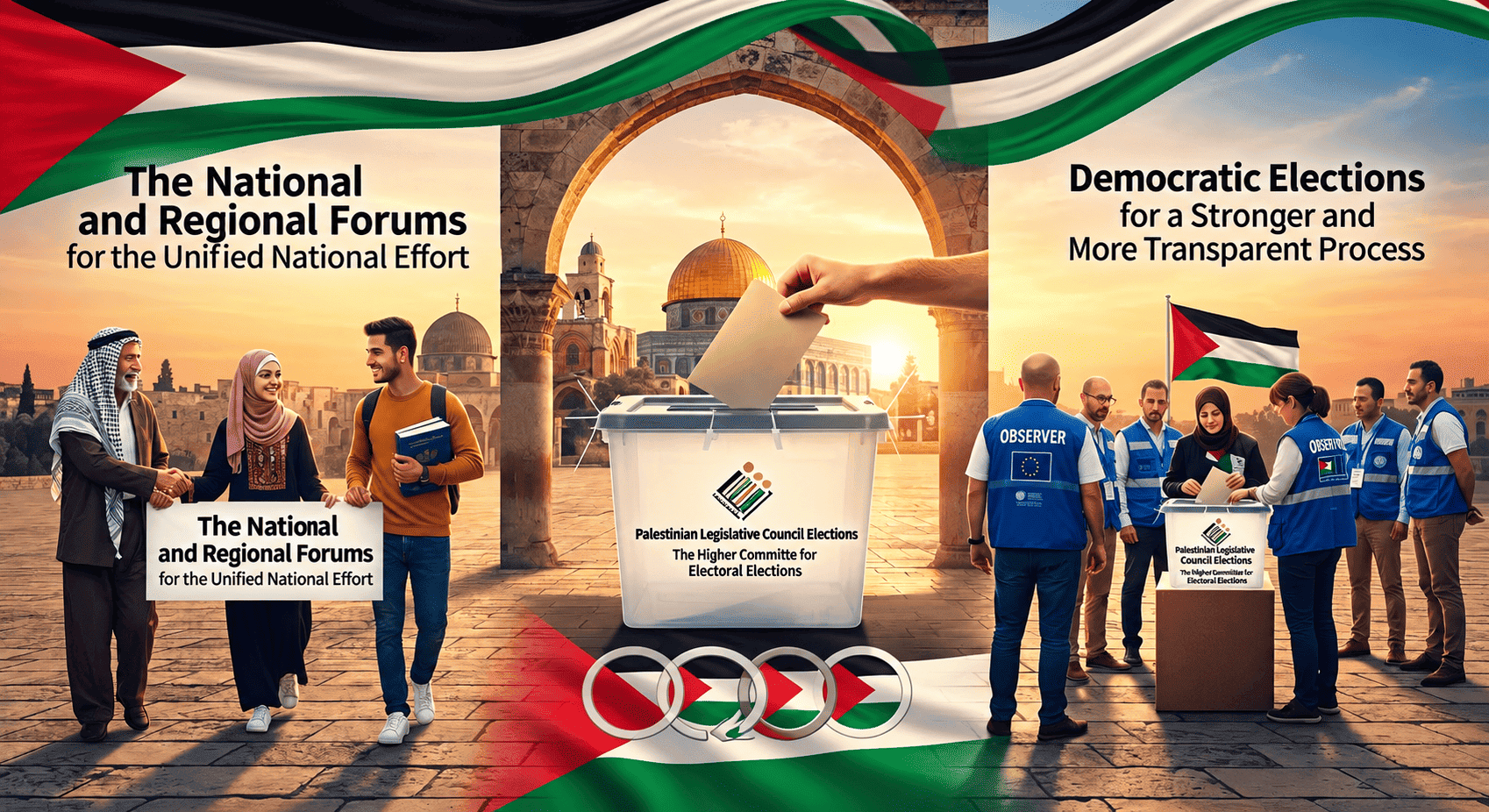

Palestinian elections face two major challenges: Israeli efforts to obstruct the electoral process and the deep internal divisions that undermine the prospects for a democratic transition. Following his recent visit to Brussels and London in late September and early October, Palestinian political analyst Hani Al-Masri highlighted these two challenges in the meetings he attended, arguing that addressing both is essential to ensuring free and fair elections whose results are respected.
Two Obstacles to Palestinian Elections
1. Israeli Obstruction and International Opposition
Al-Masri identifies the first challenge, and the more serious one, as the obstacles Israel imposes at every stage of the electoral process. These interventions have, at times, extended to overturning electoral outcomes, as happened following the 2006 Palestinian legislative elections.
He warns that the current Israeli government, which he describes as the most extremist and racist in Israel's history, is expected to go beyond obstructing elections and seek to prevent them altogether. He characterizes it as a government pursuing a policy of “resolving the conflict” by eliminating the Palestinian cause in all its dimensions, including the institutions of the Palestine Liberation Organization (PLO) and the Palestinian Authority.
According to Al-Masri, Israel does not want an elected Palestinian national entity that could gain strength and legitimacy, embody a unified national identity, connect the West Bank with the Gaza Strip, and keep open the path toward establishing a Palestinian state.
He points to the ongoing war of extermination and efforts to displace Palestinians in Gaza, the unprecedented escalation of Israeli aggression across multiple fronts in the West Bank, and developments affecting Palestinians inside Israel as clear indications of this broader strategy.
The challenge also extends to Washington. Al-Masri argues that the US administration does not currently support holding Palestinian elections, fearing that an elected Legislative Council would challenge the proposed “Board of Peace.” An elected Palestinian body, he explains, would become the legitimate authority and reference point for the West Bank and Gaza, contradicting Trump's plan, which assigns that role to the Board of Peace.
Al-Masri cautions against comparing the current circumstances with those that prevailed during previous electoral cycles, including the elections of 1996, 2005, 2006, and 2021. In his assessment, the situation today is far more dangerous and considerably worse than in those earlier periods.
2. Internal Division and the Political Leadership's Calculations
The second challenge is internal. Al-Masri points to the continued Palestinian division and what he sees as the ruling Palestinian elite's unwillingness to hold elections unless victory is assured.
He argues that the 2021 elections were cancelled because the leadership feared a substantial electoral defeat. The elections scheduled for November, he adds, were postponed following an unexpected development after the election decree was issued: Hamas's decision to participate, directly or indirectly, in the electoral process, despite earlier assumptions that the movement would either be prevented from participating or choose not to do so.
At the same time, new alliances and electoral lists began to take shape in the weeks leading up to the planned vote. These included lists bringing together Hamas, the Reformist Current, and other political forces, as well as a list led by prominent prisoner and Fatah figure Marwan Barghouti, potentially drawing support from the Reformist Current and other Fatah members and leaders.
In Al-Masri's analysis, these emerging coalitions posed a serious electoral threat to the official Palestinian leadership, raising the prospect of a decisive defeat for the incumbent leadership.
What Needs to Be Done?
Al-Masri argues that everyone committed to the Palestinian cause and to Palestinian democracy must press influential actors to address and contain both the internal and external obstacles, creating the conditions for free and fair elections whose results will be respected.
He proposes two essential requirements: international guarantees to prevent Israeli interference and national consensus on the rules governing the electoral process.
International guarantees, he argues, should help prevent Israeli attempts to block the elections, while Palestinian consensus should be built around a model of consensual democracy suited to the exceptional circumstances Palestinians face. Such an arrangement must ensure that different political forces and social groups are represented according to the share of votes they receive.
Under these conditions, elections could become a step toward unity and pluralism, strengthen the national project, and support a collective response to the existential threats facing the Palestinian people, their land, institutions, rights, national cause, and political representation.
Al-Masri further argues that international pressure, particularly from Europe, must not be directed at the Palestinian Authority alone. If European governments are genuinely committed to Palestinian democracy, they must also pressure Israel to meet the minimum internationally recognized standards required for free and fair elections whose results are respected.
Without Guarantees and Consensus, Elections Cannot Deliver Democracy
Al-Masri warns that neither international guarantees nor national consensus can be dispensed with if the aim is to hold genuinely free elections. Even if the next Israeli elections produce a less extremist government willing to tolerate a Palestinian vote, he argues, that government would still seek to intervene in the process to protect its interests and objectives and to ensure that as many supporters of the status quo as possible retain influence.
In this scenario, the Palestinian Authority would continue to function primarily as an administration managing the population under occupation rather than as an institution advancing Palestinian national self-determination.
However, Al-Masri draws an important distinction between holding elections without international guarantees and holding them without Palestinian consensus.
If national consensus can be achieved, he argues, Palestinians could proceed with elections even in the absence of international guarantees, challenging the occupation and forcing Israel to bear responsibility for preventing the vote. In such circumstances, national consensus itself could serve as a source of legitimacy until conditions allow elections to take place.
The opposite approach, he warns, would carry serious risks. Holding elections amid continued division, without a comprehensive national vision or new strategies to replace those that have reached a dead end, and treating the process as a zero-sum contest for political dominance rather than an opportunity for participation, unity, and pluralism, could deepen Palestinian fragmentation.
These risks are particularly acute amid the ongoing siege, isolation, territorial fragmentation, and separation between the West Bank, Jerusalem, and Gaza. Al-Masri also points to the destruction of the Palestinian Authority's structures in Gaza and their erosion in the West Bank as factors that could further weaken the Palestinian political system.
For Al-Masri, therefore, elections cannot be treated as an end in themselves. Their value depends on whether they help rebuild national legitimacy, bridge internal divisions, and strengthen the Palestinian national project. Without international guarantees and a genuine national consensus, elections risk reproducing the very divisions they are supposed to overcome.
Note: This is not a literal, word by word translation of the original article. It is an English adaptation that conveys all of the original article’s ideas and follows its argument and sequence. Direct quotations are taken from the original article.