
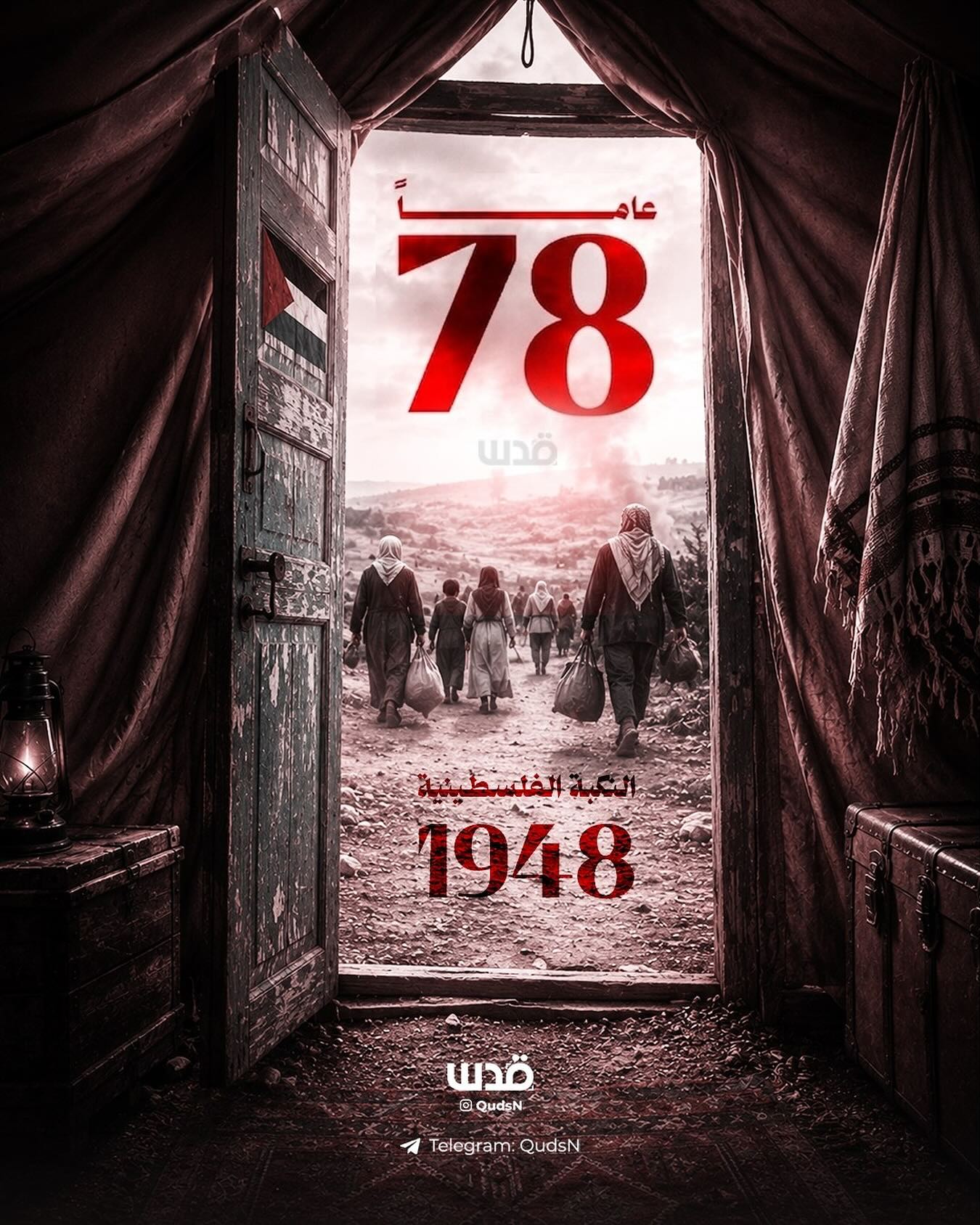

Seventy-eight years have passed since Israel was established upon the ruins of Palestinian life, yet the dust of demolished villages has never truly settled. Nearly 500 Palestinian towns and villages were erased, most of the people were scattered like seeds cast into exile, and the long campaign to uproot their identity, dissolve their rights, and erase their existence has continued ever since, especially through attempts to absorb and dilute them within their Arab surroundings. The Nakba was never a closed chapter in history; it became a road stretching across generations, and it still stretches today.
Despite the unending sacrifices of the Palestinian people, their uprisings, their grief, their endurance, and the blood of nearly 200,000 martyrs, alongside countless wounded and nearly a million imprisoned Palestinians, many of whom lost years and decades behind bars, the occupation still extends across all of Palestine like an iron shadow. Israel continues its devastation in Gaza, tightens its grip over the West Bank, entrenches systems of organized violence and racial discrimination within the territories of 1948, pursues the permanent dispersal of Palestinians in exile, and works relentlessly to erase their national identity and bury the refugee question itself. Even defending the Palestinian narrative or criticizing Israel is increasingly branded as antisemitism.
Meanwhile, the fire has spread beyond Palestine’s borders. Israel occupies additional Syrian and Lebanese lands, launches attacks against Iran, Yemen, and Iraq, and threatens confrontation with what it sees as a Sunni axis represented by Turkey and Pakistan. At the same time, it stands protected by peace treaties with Egypt and Jordan and shielded by the Abraham Accords signed with Arab states distant from the lines of confrontation. Backed openly by the administration of Donald Trump, the state built upon apartheid, displacement, annexation, and war seeks to anchor the project of “Greater Israel” and impose its dominance over the entire Middle East.
And yet, despite all of this, the Zionist movement has not fulfilled the destiny it imagined for itself. It was founded upon the claim of “a land without a people for a people without a land,” dreaming of gathering the Jews of the world into a pure Jewish democratic state promising safety and prosperity. But history resisted the slogan. Most Jews of the world did not immigrate to Israel, while the Palestinians ,the indigenous people of the land ,remain, still forming, even if by a slight margin, more than half the population living in historic Palestine.
Likewise, the Palestinian cause has refused burial. More than that, the Palestinian historical narrative now receives unprecedented recognition and belief across global public opinion, especially within the Western world that originally participated in creating Israel not to fulfill Jewish self-determination or sacred prophecy, but to serve colonial ambitions. The Zionist narrative, once dominant and unquestioned, has cracked open ,especially after the genocidal war in Gaza. Through its repeated wars, destruction, and countless crimes, Israel has increasingly appeared before the world not as a victimized democracy, but as a state of occupation, colonialism, aggression, and racial supremacy. Ironically, it has also come to seem one of the least safe places for Jews themselves.
Despite the immense disasters suffered by Palestinians, despite institutions hollowed out by the absence of elections, accountability, and democratic renewal, despite political, geographic, and institutional fragmentation that deepened even during the genocide, and despite leaderships and factions ,especially the official leadership ,remaining far below the scale of the danger and incapable of seizing available opportunities, Israel itself is increasingly viewed around the world as a threat to peace, stability, and human values. More and more, it is seen as the embodiment of a settler-colonial, replacement-based, racist project in an age where direct colonialism has lost legitimacy and racism stands globally condemned.
It is true that Israel possesses overwhelming military, economic, and technological superiority, backed without limits by the United States. Yet since October 7 until this moment, despite all the killing, destruction, displacement, and the creation of a new Nakba ,especially in Gaza ,this superiority has failed to secure a decisive victory on any front. The reason lies partly in the extraordinary steadfastness of Palestinians and their willingness to sacrifice for a cause they believe to be morally just, and partly because American-Israeli ambitions are far larger than the actual power available to realize them. The world itself is changing; unchallenged American dominance no longer governs history alone.
For that reason, today’s military victories and territorial expansions will not necessarily become lasting political or strategic triumphs. Like many powers before it, Israel may eventually find its own force turning inward against itself, producing deeper crises that intensify over time and threaten the future of the settler-colonial project itself.
Still, the defeat of Israel does not depend only on its growing internal fractures, important as they are. It also depends on the external factor ,beginning first with the Palestinian internal condition, which today stands among its weakest moments. The Palestinian political system requires not merely reform, but profound structural transformation, because its crisis is deep, layered, and impossible to overcome quickly without cumulative change and a continuous revolution in vision, leadership, institutions, policies, and methods.
This reality is inseparable from the broader Arab condition, itself weakened by fragmentation, collapse, and the absence of a unified Arab project in a region where international and regional powers compete over influence and dominance. The Palestinian question was born an international issue and has remained one ever since. It cannot be resolved without the interaction of local, Arab, regional, and international forces ,without surrendering Palestinian destiny to others, but also without exaggerating Palestinian independence in ways that sever its Arab, liberationist, and global depth or dissolve it entirely into regional and international axes.
All of this unfolds while the old world order visibly weakens and signs of a new one emerge. These shifts can be seen in the inability of Donald Trump and Benjamin Netanyahu to decisively defeat Iran or fully impose their war upon the region, as well as in their failure to secure broad American public support, international legitimacy, or even consistent European and Western cover for American-Israeli military escalation.
Perhaps the recent Chinese-American summit signals the acceleration of a transition toward a bipolar world order led by China and the United States. Such a transformation may ultimately benefit much of the world, because however flawed a bipolar order may be, a unipolar system dominated entirely by the United States has proven even more dangerous and imbalanced.
History rarely freezes forever in favor of one power. Empires often mistake temporary dominance for eternity. But peoples rooted in their land, carrying memory like fire beneath ashes, do not disappear easily. After seventy-eight years, the Nakba still continues ,but so does the Palestinian presence, the Palestinian story, and the refusal to surrender it to silence.